

Everyone wants to know about silicone implants so I decided to talk about them this week. Silicone implants were the first mainstream implants for breasts available to the US market. They were used for years and for the most part, the results were good. Most were placed above the muscle through a variety of approaches. However, there were design flaws in the implants themselves that led to a number of suits and settlements that actually put a few manufacturers out of business. The suits claimed that a number of illnesses (cancers, fibromyalgias, lupus, and many other problems) were caused by the silicone. The fact is, the more liquid silicone in the old style implants leached out over time through the capsule. This silicone was picked up in the lymphatic system and traveled into lymph nodes and other areas of the body. Because of litigation and fear, the FDA removed the implants from the market in the early 90's. The FDA authorized several companies to perfect and study silicone implants at that time.
Improvements that were made were basically to the capsule holding the silicone and to the silicone itself. The silicone was heavily cross linked to create a jelly-like substance that likes to stick together. When a hole is poked into the implant, the silicone does not flow out like liquid. It takes a fair amount of pressure on the implant to extrude the silicone. The implant can actually be cut in half....the video I made below demonstrates this.
The benefits of silicone are somewhat subjective. First, they are perceived by some to feel "more natural". Second, they have a tendency to ripple less. A photo of rippling is below.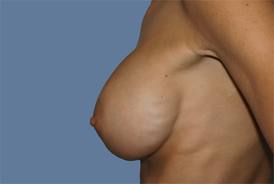 Although rippling can happen with silicone, it occurs less frequently. Silicone is a lower pressure implant and that is why. Because of this lower pressure, the upper pole is not quite as full as with saline and can look less like an implant.
The down side to silicone implants is expense. They do cost more...about $1200. The incidence of capsular contracture (when the capsule the body makes around the implant becomes tight and makes the implant feel hard) is higher...not a lot higher, but higher. Women under 22 years of age do not qualify for silicone because of FDA rules. If they do rupture, it can be difficult to detect and the FDA recommends periodic MRI of the breast for detection, however, even MRI is not that great.
Watch this video where I cut a new silicone gel implant in half. You can see the properties of the silicone.
I personally have no preference between silicone and saline. I do not like high profile saline implants because the look is not appealing. If someone wants implants under the breast instead of under the muscle, I recommend silicone. Otherwise I think they are interchangeable.
Hope this answers a few questions for you. Don't forget our specials on implants for this spring. We have great pricing that is hard to beat...call us at 918-786-7780 for details. We also have pricing on laser hair removal that I defy anyone to beat....$50 per treatment per area....wow!!
Talk next week!!

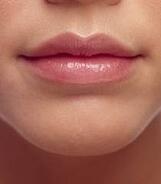 Youthful lips are generally very full and inviting. They are made of the white line where the skin and the pink mucosa of the lip join and the fullness of the lip takes off. The cupids bow is in the center of the upper lip giving definition and contrast that the lower lip is missing. Usually the lower lip is slightly larger than the upper. Youthful lips are smooth and surrounded by skin that is also smooth with uniform color and texture.
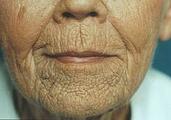 So what happened?? A number of things. Skin aging, sun damage, volume loss, i.e. fat, around and in the lip, smoking, using straws, smiling, frowning, kissing and just time. All of these things age our entire face but since the mouth is one of the centers of motion and expression in the face, like the eyes, it shows the use as we age. The lips become thin and surrounded by vertical lines, nasolabial folds, marrionette lines. The "white line" becomes less visible and the "cupids bow" becomes a straight line.
 Let's talk about eyelids for a bit. As the old Yiddish proberb says, "the eyes are the mirror of the soul"....eyes are very important. When we meet someone, where is the first place most people look??? the eyes. Therefore, if we have prematurely aging eyes, they can make us look older, more tired, and cover one of the most beautiful attributes we all have. Eyelids, though small, can change even the way we think about ourselves. We look in the mirror and even though we don't feel tired because of the "tiredness" we see in our eyes we begin to reflect it in our actions.
 Youthful eyes are wide and inviting. The upper lid is full with few wrinkles and no excess skin present. The lower lids are smooth with skin color that is pink. There are no bulges, folds, or "bags" to draw our attention from the color of the iris or the pupil. We see well as there is no abstructing skin in the way. We look and feel great.
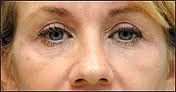 Why is this? When did it happen? How did the first picture become the second?? Well, let's get some answers. The eyelid skin is some of the thinnest skin on the body. It also moves more than the other skin and it is constantly exposed to the damaging UV rays of the sun. The other thing that happens is a loss of fatty tissue in the face. This exposes underlying connective tissue where it is tethered to bone. Lines and bulges that are normally window shaded by ample fat pads begin showing up when those fat pads diminish. Fine lines and wrinkles develope from sun damaged skin, motion, and sagging of the muscle around the eye. The process is unrelenting and over time, the sagging skin can even decrease vision.
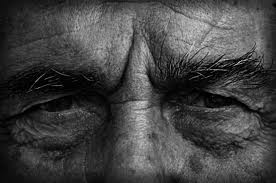 What we see here is a large amount of extra skin on the upper lid obstructing vision and the fat pad below the eye is protruding with severe skin changes. Regardless of actual age, these changes can create the image of a very old person and the view of the eye is just a slit...not a very good view of the soul.

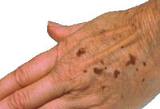 AGE SPOTS (liver spots)
.jpg) ACNE DYSCHROMIAS
ACNE DYSCHROMIAS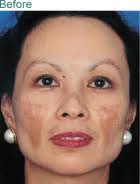 MELASMA

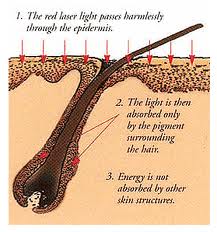.jpg) This image shows how the dark hair absorbs the laser energy and carries it to the hair creating cells in the follicle and eliminates them. Through this process, the hair becomes thinner, lighter, and in most cases, is eliminated all together. We can treat hair anywhere on the body with excellent success. In most cases it requires an average of 6 treatments for body hair and 9 treatments for facial hair. The treatments are usually spaced about 4-6 weeks apart to allow the hair to be treated in its different stages of growth. Due to new hair follicle development during life, some people may require "touch up" treatments in the future, maybe a couple of times every few years. Laser technologies do not work well on blond, white, or gray hair.
This image shows how the dark hair absorbs the laser energy and carries it to the hair creating cells in the follicle and eliminates them. Through this process, the hair becomes thinner, lighter, and in most cases, is eliminated all together. We can treat hair anywhere on the body with excellent success. In most cases it requires an average of 6 treatments for body hair and 9 treatments for facial hair. The treatments are usually spaced about 4-6 weeks apart to allow the hair to be treated in its different stages of growth. Due to new hair follicle development during life, some people may require "touch up" treatments in the future, maybe a couple of times every few years. Laser technologies do not work well on blond, white, or gray hair.

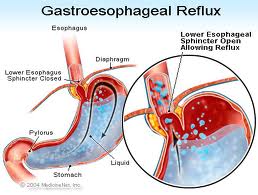 Reflux can happen to all of us. The symptom of the problem is "heart burn". Belching stomach contents into the esophagus exposes the lining of the esophagus to acid causing discomfort and at times, severe pain that can be severe enough to be mistaken for a heart attack.
 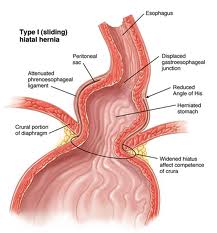 To treat this problem, in most cases, there are medications that can control it. Many times, medication can eliminate the symptoms and make the problem manageable. If not controlled, some may develope scar tissue that can lead to stricture. Others can have cellular changes that can increase cancer risk...it is a problem that should not be ignored.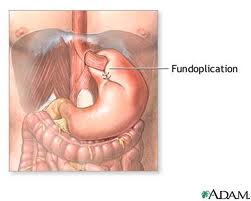
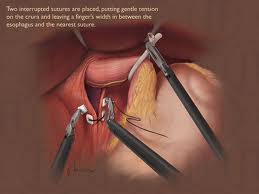
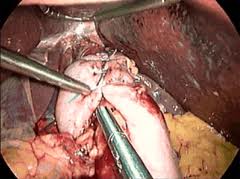 Hospital stay for this procedure is a couple of days and recovery time is fairly short.
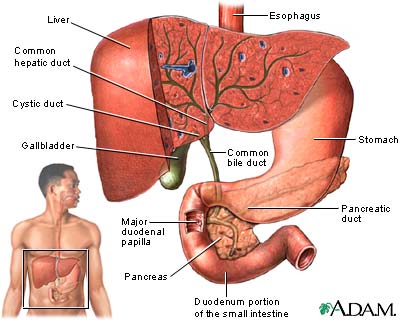
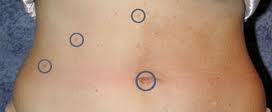 Here is a picture of gallstones....not too pretty.
 We can live normally without a gallbladder in most cases, especially a sick one. Some people may experience a little diarrhea that usually resolves but most importantly, the pain is gone. If the disease is not treated, the stones can escape the gallbladder and get into the duct causing bigger problems that we won't discuss here. The gallbladder can also become infected which can be an emergency.
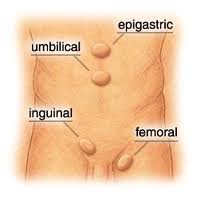 What exactly is a hernia?? Our abdominal wall is composed of layers of muscle and connective tissue. The connective tissue looks like a thin tendon. All of us who have cut up meat or a chicken have noticed the shiney layer of whitish, tough tissue that surrounds the muscles....this is connective tissue or fascia. Pound for pound it is very tough and it is responsible for holding in the contents of the abdomen and gives the muscles something to pull on when they contract. A hernia occurs when there is a hole created in this layer and contents of the abdomen poke through that hole. The mid line of the abdomen (especially the belly button) and the groins are the weakest areas and therefore are the most common sites for naturally occuring hernias. Here is a picture of an inguinal hernia...
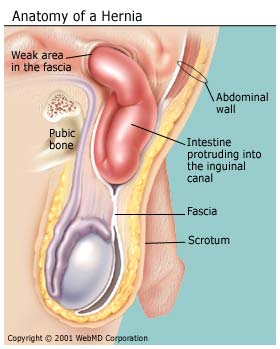 Here is a photo of what the hole looks like from the inside using a laparoscope and as you can see, with the contents removed, there is an actual hole.
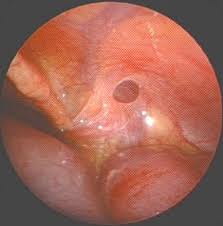 Hernias become a problem when things get stuck in them...things like intestines, fatty tissue, and other contents of the abdomen. They can also cause discomfort due to stretching of the wall of the abdomen with straining to lift, urinate, or have a bowel movement. Things can also become stuck, lose blood supply and die within the hernia. Small hernias may never cause a problem. These are the common hernias of the abdominal wall. I won't cover the more obscure ones due to time and the others are fairly uncommon.