

LAST CALL for spring breast augmentation special pricing!! It ends on the 30th at midnight. You don't have to have your surgery before then, just get your quote that will be good for 60 days. Hit this button to get all of the details.
This week, I wanted to address some of the more frequently asked questions about liposuction. Most people have a number of questions and if you have one I don't cover, email me your question to jeffswetnam@yahoo.com and I will do my best to find an answer for you.
Liposuction, as covered last week, has really grown up over the past several years. Used to be, lipo was done under general anesthesia, in a hospital, with significant blood loss, often requiring transfusion. This all changed when the tumescent techniques were developed using lidocaine and epinephrine. What this does is provide an anesthetic "block" to the area with the lidocaine (the same stuff used by the dentist to allow them to drill teeth) and limit blood loss with epinephrine as it causes constriction of blood vessels and slows the absorption of the lidocaine. Once these techniques were perfected, liposuction pretty much moved to an office procedure. With the addition of lasers, ultrasound, and other ancillary energy, we are now able to affect how the skin reacts to removing the underlying fatty tissue, i.e., we can make it contract and lose some of its sagginess.
Many questions remain. One of the most often asked questions is "what happens if I gain weight after liposuction?" To understand the answer to that question, you need to understand the reasoning behind the answer. Theoretically, we are all born with a finite number of fat cells. These cells increase or decrease in size as our weight goes up or down. With liposuction, we remove a population of these cells in the area treated. Therefore, if you gain weight, you cannot gain as much in the area treated, so, you will gain it in other places. 5-10 pounds probably will go unnoticed but 20 or 30, and you will have significant changes in other areas. You may also notice lumpiness in the treated areas as the fat cells that are left (we cannot remove them all) will grow in size.

The second question often asked is will my skin shrink? This is also a great question. I look at the quality of the skin and evaluate it prior to recommending liposuction. If the skin in the lower abdomen say, has numerous stretch marks, wrinkles and scars, then liposuction may not be the best choice as we are expecting poor quality skin to contract and smooth out. For the abdomen, in the person mentioned above, I would probably recommend a tummy tuck instead. Skin that has no stretch marks, no scars, and is good quality anyway will usually respond well. We use the laser to promote the skin contracture and also to make the procedure less traumatic.
The third question is usually, how much can I do at one time?? The answer to this question requires a multiple part answer. First, how big are the areas? We can do multiple small areas at one time. Larger areas may have to be devided up. Why?? Well, it depends on how much lidocaine we have to use, and, how much fat we are going to remove. Of course, there are limits on the amount of lidocaine we can use based on a persons weight. We also usually don't remove more than 4 liters of fat (two, 2 liter coke bottles full) at each setting as rates of complication increase exponentially when 4 liters is exceeded. I try to estimate how much fatty tissue will be removed from each area and make a plan accordingly.

Well, that's enough for this week! Again, if you have a question you would like addressed about liposuction, or anything else, email me and we'll do our best to address it.
Remember, Cosmetic consults are complimentary so call 918-786-7780 or 1-866-weight0 TODAY!!


 In this picture, the nipple position is great, the skin is tight, and only an implant is necessary. After implant placement, the skin will stretch to accomidate the implant and the breast will take on a nice and natural shape. This is the perfect patient for implants alone. As discussed in earlier blogs, the incision placement options, size, and type of implants are variable according to taste. At your consult, all of this will be discussed and you can decide.
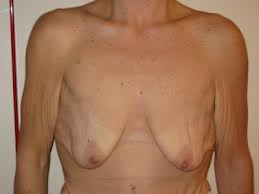 This picture depicts one of the "easy" decisions. Obvious drooping of the breast and nipple complex below the lower fold of the breast where it attaches to the chest. If we were to just place an implant in this situation, there would be a nice implant present with a sagging breast hanging off with the nipple still pointing at the floor. Several procedures are used to lift the breast. We usually use the Weiss pattern lift (anchor incision) for larger lifts and the vertical (lolly pop) lift. Both types of lift raise the nipple into a more normal position, remove excess skin below the breast and move remaining breast tissue into a higher position. In the picture above, we call this the "rocks in socks" breast. There is some breast tissue hanging around the nipple (rocks), and skin (socks). If lifted only, this will be a very small and flat breast. This is when an implant can really be beneficial to give the breast some volume. Others have a sagging nipple and breast but still have a good amount of volume. A lift alone, or with implants are both choices.
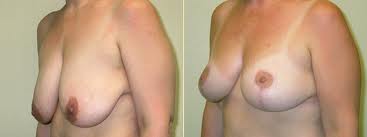 This is a photo of a breast lift alone. The shape is nice and nipple position is good, however, the upper pole remains flat. This can only be fixed, long term, with an implant. Implants, however, can be placed after a lift so you can decide later if you want them or not.
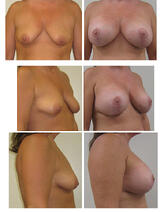 As you can see, a lift with an augmentation can be done simultaneously with good results. This gives good fullness to the upper pole of the breast with the added benefit of only one procedure.
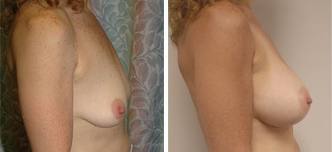 Breast pseudoptosis with implants. Looks pretty good, but upper pole is somewhat flat. If this is acceptable, it is a great choice.

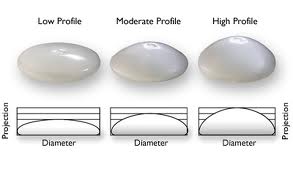 There is a new higher profile not pictured here.
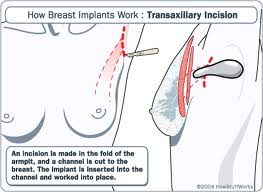 Arm pit incision-saline or silicone.
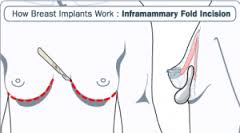 The incision is only 2-4cm, not this big!! Saline or silicone.
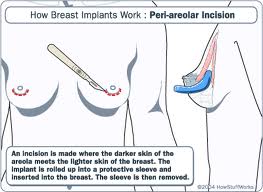 incision around the nipple. Saline or silicone.
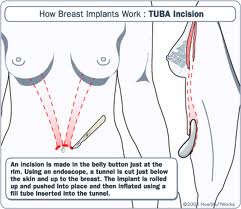 Silicone cannot be placed through the belly button.

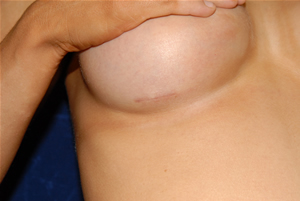

 Capsular contracture on right with implant thightening and displacement. It would feel very hard if you could feel it.
 implant "rippling"