

Many questions exist about liposuction. Most people have an image of a very violent and bloody procedure with results that are less than optimal. Todays liposuction is much different. Due to techniques we use today, liposuction can be done in the office, with only sedation. I would like to address a number of questions that are commonly asked of me during a consult, and many points that I like to talk about with patients to help them understand what they are to expect.
First, will I get fat in other areas after liposuction? This is one of the more common questions I am asked. The theory is that we are all born with a finite number of fat cells. As we gain or lose weight, we do not gain or lose these cells, they just grow or shrink in size. Some data show that in the super obese, cell numbers may actually increase but we don't liposuction these people. During liposuction, we remove fat cells in the area we are treating. Therefore, if someone gains weight after liposuction, it will accumulate in other areas since we have removed the fat cells in the area they have gained in before. This is true, however, to make a significant difference, it has to be a significant amount of weight....20-30 lb. Most people that spend the money on this type of procedure are not going to let this happen.
Second, will I get lumpy in the area of liposuction? This can happen, especially after weight gain. If you think about the procedure, we are removing layers of fat...not all of the fat. Some remains. This is a good thing. Leaving a layer of fat below the skin allows the skin to remain smooth and supple. Oversuction can create dents and allow the skin to scar to connective tissue underneath....both bad things. With some live fat remaining, if you gain weight, these pockets of fat cells will increase in size and can form areas of lumpiness. Lumps in the immediate period after liposuction are a normal thing. Usually they are a little sore and represent areas where fat has been damaged and the body is breaking them down. I like for people to massage these areas to speed up the process. It can take several weeks to months for them to completely resolve.
Third, will my skin be saggy after the procedure. This is the thing that is hardest to predict. The things I look for are the ones that indicate skin quality before the procedure. For example: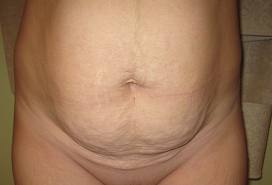 The stretch marks in this photo would indicate to me that a tummy tuck would be a better choice for her...why? Her skin will have less of a chance of contracting after the fat is removed because of the poor starting skin quality. It will be more likely than not that her skin will not contract. This does not rule out liposuction for her but she must understand that, in clothes, she will look better and more sculpted, but in a swimming suit, the skin will still look bad and possibly more saggy. If her skin were smooth, she would be a much better candidate.
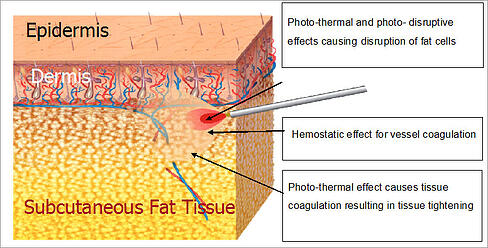
Fourth, will the newer technologies help the final result? Yes and no is the answer. Laser and ultrasound technology have helped but they are not the silver bullet. I like to use them as an adjunct to traditional liposuction. The idea is that heating the skin from the inside does cause some contraction, how much is the unknown. I remove the fat first then use the laser to heat the skin to allow skin contraction. Several studies have been done that indicate the use of these technologies alone are sub-optimal and my experience verifies this.
We do liposuction often and combine it with many procedures. It is a great procedure and helps a lot of people. We do the procedure in the office with sedation and tumescent solution. This solution contains lidocaine that numbs the area and also epinephrine that causes the small blood vessels to contract and limits blood loss. Patients recover quickly and this depends on the size of the treatment area. It takes the skin several months to contract and heal so the final result is seen after 3-4 months.
Come see us for a consult and for a limited time receive 10% off of the procedure. Don't forget our laser and breast offers too!!!!
918-786-7780


.jpg?width=277&height=184&name=images_(30).jpg) We start with an easy one. If you said tummy tuck, you would be right. There is no doubt there is a lot of fatty tissue present and liposuction COULD be considered, however, the hanging skin would only become worse. A tummy tuck with associated liposuction of the waist would be the appropriate choice. The tummy tuck would remove the excess skin and stretch marks below the belly button and liposuction of the waist would accent and renew the shape of the sides of the abdomen.
We start with an easy one. If you said tummy tuck, you would be right. There is no doubt there is a lot of fatty tissue present and liposuction COULD be considered, however, the hanging skin would only become worse. A tummy tuck with associated liposuction of the waist would be the appropriate choice. The tummy tuck would remove the excess skin and stretch marks below the belly button and liposuction of the waist would accent and renew the shape of the sides of the abdomen..jpg) This one is a little tougher. When you look at this abdomen what do you see? As far as fatty tissue goes, there is only a problem area in the mid abdomen and a lower abdominal pooch. Normally, this would be a perfect abdomen for liposuction, however, you always must evaluate the skin quality too. The skin in the lower abdomen is riddled with stretch marks. For this reason, I would recommend a tummy tuck. The tummy tuck removes a majority of the stretch marks, tightens the remaining ones and moves them below the pant and swim suit line. Of course if she presented not caring about skin quality after the procedure, a liposuction procedure could be selected. I would doubt the level of satisfaction after liposuction alone.
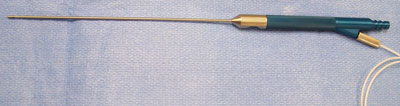
This one is a little tougher. When you look at this abdomen what do you see? As far as fatty tissue goes, there is only a problem area in the mid abdomen and a lower abdominal pooch. Normally, this would be a perfect abdomen for liposuction, however, you always must evaluate the skin quality too. The skin in the lower abdomen is riddled with stretch marks. For this reason, I would recommend a tummy tuck. The tummy tuck removes a majority of the stretch marks, tightens the remaining ones and moves them below the pant and swim suit line. Of course if she presented not caring about skin quality after the procedure, a liposuction procedure could be selected. I would doubt the level of satisfaction after liposuction alone..jpg) Not exactly a clinical photo, but, it makes a point. This girl is the perfect example for liposuction. Perfect skin, nice shape overall, and just a small area of fat in the lower and mid abdomen....what a pallet!! I could make this abdomen look amazing. I would use a small cannula, remove the fatty tissue and give her some definition. I would then use the cool touch laser to tighten the skin more. It would look fantastic.
Not exactly a clinical photo, but, it makes a point. This girl is the perfect example for liposuction. Perfect skin, nice shape overall, and just a small area of fat in the lower and mid abdomen....what a pallet!! I could make this abdomen look amazing. I would use a small cannula, remove the fatty tissue and give her some definition. I would then use the cool touch laser to tighten the skin more. It would look fantastic..jpg) This abdomen is a little tougher. The skin looks pretty good. The shape is fair with some fatty pockets that could easily be removed with liposuction. Liposuctioning the waist would also improve her shape into a more hourglass look. BUT, what about the C-section scar? It is a point of adherence that liposuction will not address. I would recommend a mini tummy tuck with liposuction. This would allow me to tighten the lower abdominal skin, remove the C-section scar, and liposuction the waist. I would not make an incision around the belly button but remove some skin that will make it look better.
This abdomen is a little tougher. The skin looks pretty good. The shape is fair with some fatty pockets that could easily be removed with liposuction. Liposuctioning the waist would also improve her shape into a more hourglass look. BUT, what about the C-section scar? It is a point of adherence that liposuction will not address. I would recommend a mini tummy tuck with liposuction. This would allow me to tighten the lower abdominal skin, remove the C-section scar, and liposuction the waist. I would not make an incision around the belly button but remove some skin that will make it look better.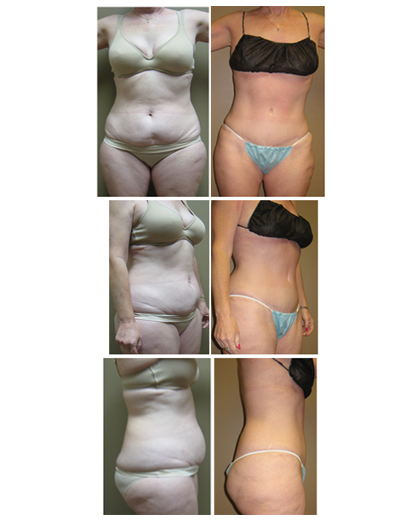
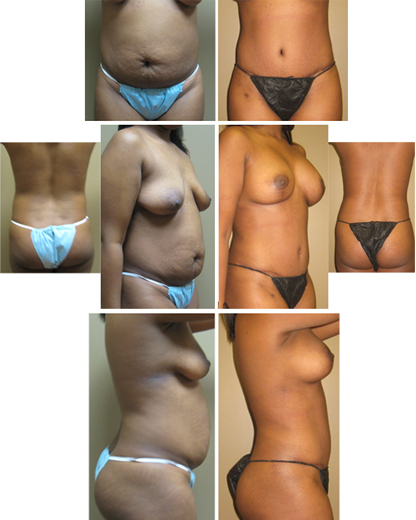



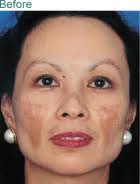 (melasma or brown spots from the sun)
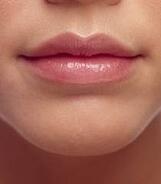 Youthful lips are generally very full and inviting. They are made of the white line where the skin and the pink mucosa of the lip join and the fullness of the lip takes off. The cupids bow is in the center of the upper lip giving definition and contrast that the lower lip is missing. Usually the lower lip is slightly larger than the upper. Youthful lips are smooth and surrounded by skin that is also smooth with uniform color and texture.
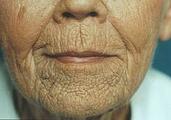 So what happened?? A number of things. Skin aging, sun damage, volume loss, i.e. fat, around and in the lip, smoking, using straws, smiling, frowning, kissing and just time. All of these things age our entire face but since the mouth is one of the centers of motion and expression in the face, like the eyes, it shows the use as we age. The lips become thin and surrounded by vertical lines, nasolabial folds, marrionette lines. The "white line" becomes less visible and the "cupids bow" becomes a straight line.
 Let's talk about eyelids for a bit. As the old Yiddish proberb says, "the eyes are the mirror of the soul"....eyes are very important. When we meet someone, where is the first place most people look??? the eyes. Therefore, if we have prematurely aging eyes, they can make us look older, more tired, and cover one of the most beautiful attributes we all have. Eyelids, though small, can change even the way we think about ourselves. We look in the mirror and even though we don't feel tired because of the "tiredness" we see in our eyes we begin to reflect it in our actions.
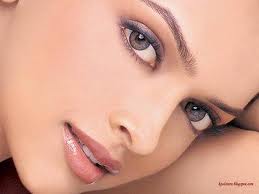 Youthful eyes are wide and inviting. The upper lid is full with few wrinkles and no excess skin present. The lower lids are smooth with skin color that is pink. There are no bulges, folds, or "bags" to draw our attention from the color of the iris or the pupil. We see well as there is no abstructing skin in the way. We look and feel great.
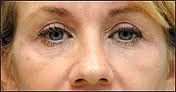 Why is this? When did it happen? How did the first picture become the second?? Well, let's get some answers. The eyelid skin is some of the thinnest skin on the body. It also moves more than the other skin and it is constantly exposed to the damaging UV rays of the sun. The other thing that happens is a loss of fatty tissue in the face. This exposes underlying connective tissue where it is tethered to bone. Lines and bulges that are normally window shaded by ample fat pads begin showing up when those fat pads diminish. Fine lines and wrinkles develope from sun damaged skin, motion, and sagging of the muscle around the eye. The process is unrelenting and over time, the sagging skin can even decrease vision.
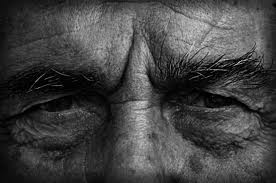 What we see here is a large amount of extra skin on the upper lid obstructing vision and the fat pad below the eye is protruding with severe skin changes. Regardless of actual age, these changes can create the image of a very old person and the view of the eye is just a slit...not a very good view of the soul.



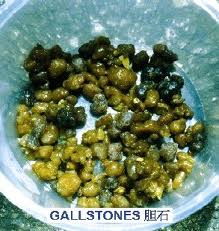
 Here is a picture of gallstones....not too pretty.
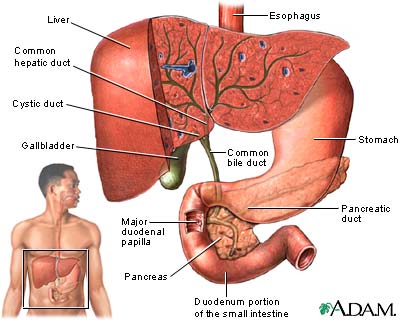
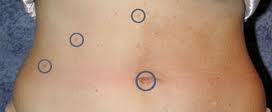
 We can live normally without a gallbladder in most cases, especially a sick one. Some people may experience a little diarrhea that usually resolves but most importantly, the pain is gone. If the disease is not treated, the stones can escape the gallbladder and get into the duct causing bigger problems that we won't discuss here. The gallbladder can also become infected which can be an emergency.

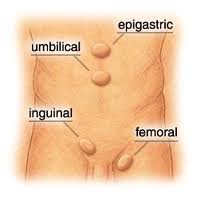 What exactly is a hernia?? Our abdominal wall is composed of layers of muscle and connective tissue. The connective tissue looks like a thin tendon. All of us who have cut up meat or a chicken have noticed the shiney layer of whitish, tough tissue that surrounds the muscles....this is connective tissue or fascia. Pound for pound it is very tough and it is responsible for holding in the contents of the abdomen and gives the muscles something to pull on when they contract. A hernia occurs when there is a hole created in this layer and contents of the abdomen poke through that hole. The mid line of the abdomen (especially the belly button) and the groins are the weakest areas and therefore are the most common sites for naturally occuring hernias. Here is a picture of an inguinal hernia...
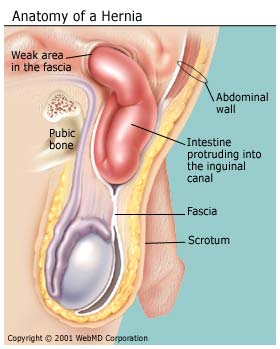 Here is a photo of what the hole looks like from the inside using a laparoscope and as you can see, with the contents removed, there is an actual hole.
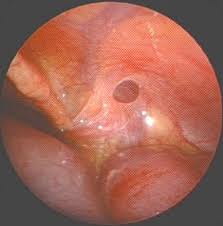 Hernias become a problem when things get stuck in them...things like intestines, fatty tissue, and other contents of the abdomen. They can also cause discomfort due to stretching of the wall of the abdomen with straining to lift, urinate, or have a bowel movement. Things can also become stuck, lose blood supply and die within the hernia. Small hernias may never cause a problem. These are the common hernias of the abdominal wall. I won't cover the more obscure ones due to time and the others are fairly uncommon.