



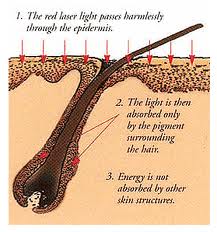
Last week we talked about treatment of facial redness, facial veins, and rosacea as a cause. Most of these treatments involve some type of light therapy or laser treatments. The laser is used to close visible veins on the face and at the base of the nose. It works by damaging the lining of the vein, it ceases to function, and your body eventually gets rid of it. Of course, some new veins may appear with time and may require further treatment.
 just a reminder..
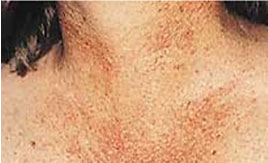
For the redness associated with aging and, or rosacea, we use IPL (intense pulsed light). The intensity of the pulse of light also targets the red pigment in the smaller capillaries of the skin of the face, causing them to close. After a short time, the redness is much less. In many cases, we will use the laser and IPL at the same time, closing the larger, visible veins with the laser and the generalized redness with IPL. The IPL treatments also can target "age" spots on the face, or areas of Melasma (mask of pregnancy or pigmented areas).
 melasma
  age spots
These areas are caused by Ultraviolet light (sun) exposure and hormonal changes. This is why we recommend not tanning your face!!!, or use sun screen on your face and re-apply often.
OK, after this reminder of what we are trying to address with the laser...what is, and why do you need "pre-treatment"? First of all, we want the treatments to be as effective as possible. If you pre-treat the skin, the dead layer or stratum corneum is not as thick and the light used penetrates better. This, of course, gives a better result. The other problems that can occur with light therapy are:
-hyperpigmentation: in other words, the skin cells that produce the pigment in the first place can respond by making more....not what we're looking for.
-hypopigmentation: loss of skin color. The pigment cell stop working and the skin becomes too light.
-persistant redness: redness of the skin after treatment that can hang on for months.
Of course the percentage of people that have any one of the three of these happen is very low, however, we want to decrease the risk as much as possible. How do we do this?....by pre-treating the skin of course.

What we, and most others, use is a combination of a retinol compound, and a fading agent. Retinol compounds are derivatives of vitamin A. (retinol, retin-a, tretinoin, etc.) There are chemical differences between them, but the end result is to compact or thin the outer, dead layer of skin and stimulate the live, basal layer to turn over quicker and thicken. They also retard the degradation of collagen and slow down the darker pigment cells that create dark spots. All retinols will also dry the skin to some extent and decrease oil production. These effects are great for acne and for some forms of rosacea. The other product we use is a hydroquinone. Hydroquinone works by inhibiting an enzyme in the melanocyte (the cell in the skin that produces pigment) that is critical in forming the melanin or dark pigment. By stopping this pigment production before any light treatment, we can decrease the likelihood of hyperpigmentation as a problem. The continued use, after laser or light therapy, of hydroquinone keeps the age spots and, or melasma from returning.
Of course, pre-treatment does not guarantee that any one, or all, of the problems that can occur will be prevented. But pre-treatment does greatly lower the chances. The darker the skin, i.e., ethinic skin, the greater the chance of problems with or without treatment.
At Total Body Surgical, we use the Obagi line of skin care products for pre-treatment and maintenance. It is medical grade (prescription grade) and works very well even if laser or light therapy is not used. Our pricing is great and we start people on the travel size products so they don't buy large amounts to start with. If your skin cannot tolerate it, (very unusual) or if you don't like it, you have not made a huge investment.

So come see us for facial pigment issues, rosacea, or acne. We have the experience and equipment to help you. Cosmetic consultations are complimentary so call 918-786-7780 or 1-877-weight-0.

 In this picture, the nipple position is great, the skin is tight, and only an implant is necessary. After implant placement, the skin will stretch to accomidate the implant and the breast will take on a nice and natural shape. This is the perfect patient for implants alone. As discussed in earlier blogs, the incision placement options, size, and type of implants are variable according to taste. At your consult, all of this will be discussed and you can decide.
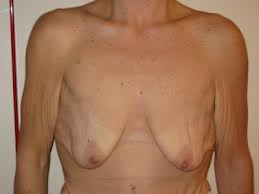 This picture depicts one of the "easy" decisions. Obvious drooping of the breast and nipple complex below the lower fold of the breast where it attaches to the chest. If we were to just place an implant in this situation, there would be a nice implant present with a sagging breast hanging off with the nipple still pointing at the floor. Several procedures are used to lift the breast. We usually use the Weiss pattern lift (anchor incision) for larger lifts and the vertical (lolly pop) lift. Both types of lift raise the nipple into a more normal position, remove excess skin below the breast and move remaining breast tissue into a higher position. In the picture above, we call this the "rocks in socks" breast. There is some breast tissue hanging around the nipple (rocks), and skin (socks). If lifted only, this will be a very small and flat breast. This is when an implant can really be beneficial to give the breast some volume. Others have a sagging nipple and breast but still have a good amount of volume. A lift alone, or with implants are both choices.
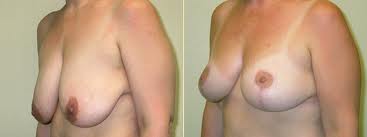 This is a photo of a breast lift alone. The shape is nice and nipple position is good, however, the upper pole remains flat. This can only be fixed, long term, with an implant. Implants, however, can be placed after a lift so you can decide later if you want them or not.
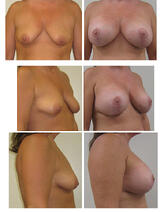 As you can see, a lift with an augmentation can be done simultaneously with good results. This gives good fullness to the upper pole of the breast with the added benefit of only one procedure.
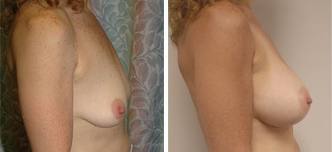 Breast pseudoptosis with implants. Looks pretty good, but upper pole is somewhat flat. If this is acceptable, it is a great choice.
.jpg)


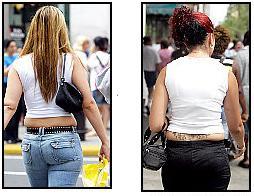 The dreaded "muffin top"
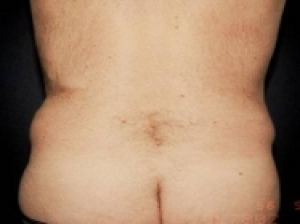 "love handles"...not so lovely
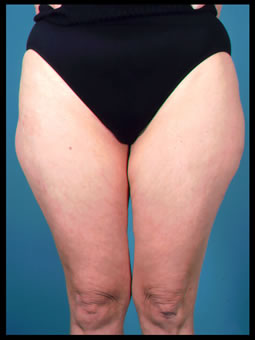 Fatty thighs...saddle bags, inner thighs, anterior thigh, and fatty knees.
 Fat abdomen


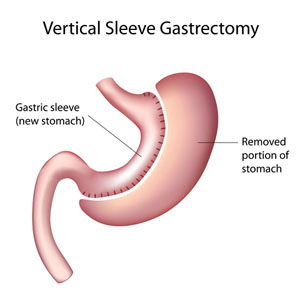 The gastric sleeve decreases the amount of food that can be consumed when eating a meal. It also decreases the amount of the hormones produced by the stomach that causes hunger and the desire to eat. This is a proven procedure that is done through the laparoscope with an over night stay in most cases. The weight loss is dramatic with no adjustments.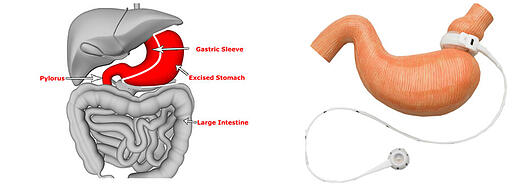

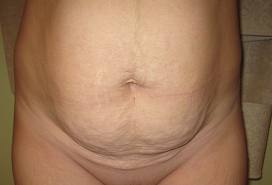 The stretch marks in this photo would indicate to me that a tummy tuck would be a better choice for her...why? Her skin will have less of a chance of contracting after the fat is removed because of the poor starting skin quality. It will be more likely than not that her skin will not contract. This does not rule out liposuction for her but she must understand that, in clothes, she will look better and more sculpted, but in a swimming suit, the skin will still look bad and possibly more saggy. If her skin were smooth, she would be a much better candidate.

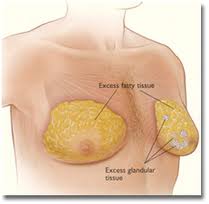 Gynecomastia during adolescence is made of fatty tissue with a bud of breast tissue under the nipple. By the early 20's it should be gone, if not, it may become a real problem. The problems it causes are not generally physical but psychological. Wearing normal clothing becomes an uncomfortable situation for a guy that has breast tissue and makes one very self conscious. Working out to develop pectoral muscles can often times only make things worse...so what's a guy to do??
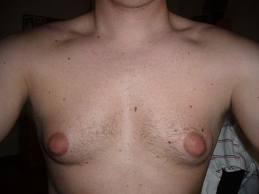 First of all, be patient. It is hard to do but fortunately, in a majority of cases the problem resolves after hormone changes settle down. In cases that don't resolve, we can take care of the problem. Usually, in the normal case, I will liposuction the chest and remove the "bud" of breast tissue. I do this through a small incision in the arm pit to liposuction the chest of excess fatty tissue. I then make an incision through the nipple to remove the small bud of breast tissue. We do this in the office procedure room using some IV sedation and tumescent local. It takes less than an hour and can be life changing. We have you wear a compression shirt for about 3 weeks and from that point on, normal clothes can be worn without the worry of those two little reminders poking through. The incisions heal very well and go unnoticed after a healing time of a few months.